Bangley’s ban on Hig visiting the sick family
The Dog StarsBangley’s ban on Hig visiting the sick family turns a practical fear of infection into a test of what survival requires. Bangley treats contact with the vulnerable Mennonite families as a danger to be excluded; Hig regards their need for help, and their evident lack of aggression, as reasons the boundary cannot simply settle the matter. Their disagreement exposes a persistent conflict between protection and responsibility, with no evidence that either man’s position is finally resolved by the rule itself.
The Rule and Its Basis
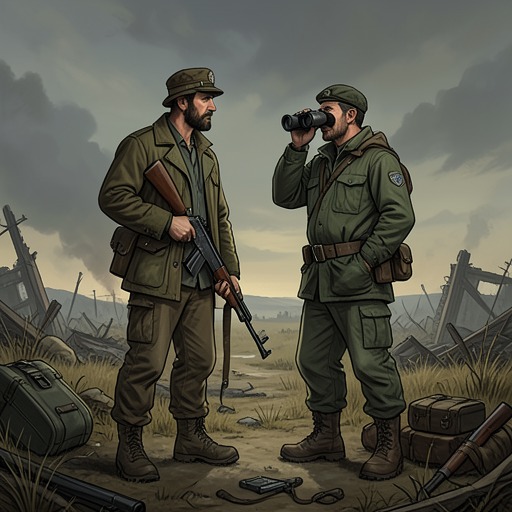
Bangley challenges Hig about his visits by comparing them to visits to other religious communities, first asking about the Druids and then the Mormons. The questions are pointed rather than neutral: Bangley stands very straight and leans forward subtly when angry, and Hig recognizes that he is being provoked. The exchange makes clear that the dispute is not merely logistical. Bangley is pressing Hig to defend why he crosses a boundary that, in Bangley’s view, should already be understood.
Hig counters that the restriction was not a promise made between the two men: Bangley says Hig agreed with himself, and declares the subject off limits. That response frames the ban as a rule Bangley expects Hig to observe without reopening the argument. It also leaves the source of its authority contested. Hig does not accept that an instruction becomes decisive simply because Bangley treats it as settled; he continues to give reasons for his visits, even as the exchange shows how directly the rule bears on their partnership.
One of Bangley’s stated concerns is the possibility that Hig could survive the immediate dangers only to die of the blood disease. Hig questions whether the danger has been proven, but does not claim that helping is risk-free. His answer is that every part of their existence involves risk, and that the families occasionally need his assistance. The rule therefore stands between two competing assessments of danger: Bangley emphasizes exposure that might threaten their own survival, while Hig weighs that uncertain exposure against concrete needs he can address.
Hig’s Reasons for Crossing the Boundary
Hig describes the families as people trying to stay alive from day to day, not as an enemy group. He says they pose no threat to him and Bangley, and mentions rumors that some people have survived the illness. These points do not disprove Bangley’s concern; rather, they show why Hig will not let uncertainty about infection erase the families’ humanity or their prospects. His position is neither that danger is absent nor that every risk should be ignored. He argues that risk must be weighed against what help can do.
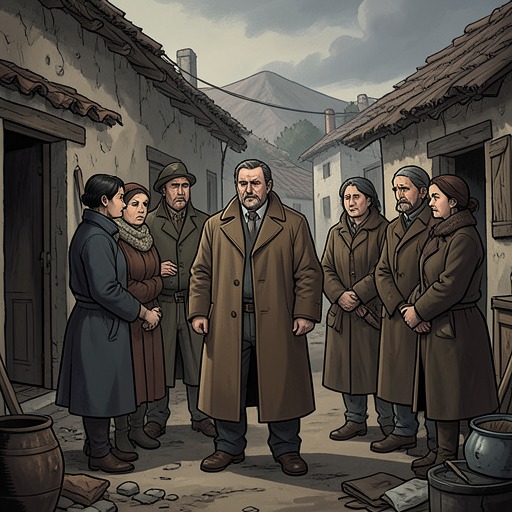
The visits have specific, modest purposes. Hig repairs a pump and shows family members how to make a fish trap for the creek. These tasks place his assistance in the practical work of staying alive: water equipment and food gathering, rather than any larger plan to transform the settlement. The families maintain a fifteen-foot distance, a limit Hig says he has trained them to keep. He reports that they have never shown aggression and respond with gratitude, sometimes with more gratitude than he knows how to receive. Their conduct matters to his argument because it gives the boundary a human reality: these are people following precautions while accepting help, not a hostile force pressing in on the airport.
Hig also acknowledges that the visits help him. He says that he does the work as much for himself as for the families, because it loosens something inside him that had nearly frozen. That admission complicates any simple contrast between self-preservation and altruism. Assistance answers immediate needs outside the perimeter, but it also affects Hig’s own capacity to remain emotionally open within a life organized around danger. Bangley’s rule would protect one kind of survival; Hig’s repeated crossings preserve another, without removing the risk Bangley fears.
Boundaries, Trust, and the Partnership
The fifteen-foot separation is a practical boundary Hig enforces even as he rejects Bangley’s broader prohibition. That distinction is important: Hig does not describe the visits as unrestricted contact. He has trained the families to remain back, and he presents their compliance as part of the evidence that the arrangement has been workable. The rule and the distance are thus different forms of control. Bangley seeks to keep Hig away; Hig manages contact by setting and maintaining a limit.
Their argument also reveals strain in the survival partnership. Bangley challenges Hig’s judgment, makes the matter off limits, and treats the visits as a threat to their shared security. Hig answers by defending the families’ character and the value of his work, rather than accepting Bangley’s assessment as binding. The account does not show Bangley changing his mind or the two men reaching a lasting agreement. Instead, the prohibition remains a pressure point: their cooperation depends on common defenses, while their understanding of who deserves help does not fully coincide.
Later Medical Context
A later episode involving Cima and a Mennonite family offers a different perspective on the danger that underlies the ban. Cima, acting as a doctor, examines the family in a room of an old farmhouse. Wearing latex gloves, she treats cuts and wounds, calls for warm water, advises a pregnant young woman, and comforts an older man. The scene depicts care taking place through precautions and organized attention, rather than through avoidance of the patients altogether.
Cima tells Hig that he may come across and mingle, explaining that the danger of ordinary contact has been misunderstood. She compares the issue to hepatitis C and to HIV as it was once understood, and identifies fluid and blood transfer as the relevant concern. This medical explanation gives the earlier dispute a concrete complication: the question is not simply whether the sick are dangerous, but what kinds of contact carry risk and what precautions make care possible. The evidence does not establish that Bangley accepts Cima’s view, that his ban is formally revoked, or that Hig’s earlier visits were medically risk-free.
Significance
The rule gives visible form to a conflict that the broader survival arrangement cannot eliminate. Bangley seeks safety by drawing a firm perimeter around the people he and Hig must protect. Hig keeps that perimeter from becoming an absolute moral boundary: he accepts precautions, but continues to see need beyond it and acts on that recognition. The pump, the creek fish trap, and the families’ maintained distance make the conflict concrete, while Hig’s admission that helping also loosens something in him reveals its inward consequence. Cima’s later medical judgment reframes the boundary without supplying a definitive resolution. The prohibition remains significant because it marks the point where a shared commitment to survive meets disagreement about what, and whom, survival is for.